
Workouts.
How today's plan is built, how the weight coach picks every number on the bar, how workout calories and XP are counted, and how muscle recovery steers what you train next.
Training goals
Your training goal sets the reps, sets and rest for every exercise. It starts from your profile goal (Lose weight → Lose fat, Build muscle → Build muscle, Maintain → General fitness, Endurance → Endurance) and you can change it any time. Big lifts are compound lifts like squats, presses and rows; small lifts work one joint, like curls.
| Goal | Big lifts | Small lifts | Sets (beg. / int. / adv.) | Rest big / small |
|---|---|---|---|---|
| Get stronger | 4–6 reps | 8–10 reps | 3 / 4 / 5 | 180 s / 90 s |
| Build muscle | 6–10 reps | 10–15 reps | 3 / 3 / 4 | 120 s / 75 s |
| Lose fat | 10–15 reps | 12–20 reps | 3 / 3 / 3 | 60 s / 45 s |
| Endurance | 15–20 reps | 15–25 reps | 2 / 3 / 3 | 45 s / 30 s |
| General fitness | 8–12 reps | 10–15 reps | 3 / 3 / 3 | 90 s / 60 s |
Each goal also leaves 2 reps in reserve (3 for Endurance), so the working weight is a share of your one-rep max: about 81% for Get stronger, 75% for Build muscle, 71% for General fitness, 68% for Lose fat and 63% for Endurance.
share of 1-rep max = 1 ÷ (1 + (reps + reps in reserve) ÷ 30)
Bodyweight moves scale their reps instead: × 0.8 for Get stronger, × 1.2 for Lose fat, × 1.5 for Endurance. Lose fat adds a short finisher to sessions of 30 minutes or more: 2 fast moves (3 from 75 minutes), 2 sets each with 15 seconds' rest.
How today's plan is built
- Your settings: 15, 20, 30, 45, 60, 75 or 90 minutes (30 by default); focus Smart pick, Full body, Upper body, Lower body, Core, Cardio & HIIT or Mobility; No equipment, Home Gym or Gym, with the equipment you tick; Beginner, Intermediate or Advanced.
- Weekly goal: 3 workouts by default (1–7). If you pick training days, your goal is that number of days, and the other days are rest days with an optional stretch of up to 20 minutes. Train anyway brings the full plan back.
- Picking exercises: each one is scored on how fresh its muscles are, covering muscles you haven't worked, variety, a balance of movement patterns and fit with your equipment, with a little randomness. Big lifts go first, then the rest, then core, then any finisher and cool-down.
- Fitting your time: sessions of 20 minutes or more start with a warm-up move and sessions of 30 minutes or more end with a stretch. Sets per move are capped at 2 for 15 minutes, 3 for 20, 4 for 30 and 5 above that. Moves are added until the plan reaches your time, then sets are trimmed or added to land within 90–105% of it.
- Plan estimate: each set takes its timed length, or 3 seconds a rep (at least 8 reps' worth), plus its rest and 30 seconds of set-up per exercise.
- Programs: 8 built-in programs, from Start Strong (4 weeks × 3) to Strength 5×5 (12 weeks × 3). Reps go up each week by the program's step.
The plan stays the same all day and rebuilds when the day changes, when you change a setting, or when you tap Shuffle.
Muscle recovery
Each muscle group you train is tired at first and fully fresh again 72 hours later.
fatigue = 1 − hours since trained ÷ 72 (between 0 and 1)
- Light work tires you less: cardio and single timed sets count as if done 48 hours earlier. Logged runs, rides and sports count as 36 hours earlier, walks and yoga as 60. Stretches don't count.
- An exercise whose two main muscle groups are more than 50% tired is left out of today's plan, unless that leaves fewer than 4 to choose from.
- Smart pick compares your upper and lower body: Full body when both are over 85% fresh, Core or Mobility when both are under 50%, otherwise whichever half is fresher.
- Labels: under 24 hours "Recovering", 24–48 hours "Almost ready", 48–72 hours "Ready", over 72 hours "Fresh".
The weight coach
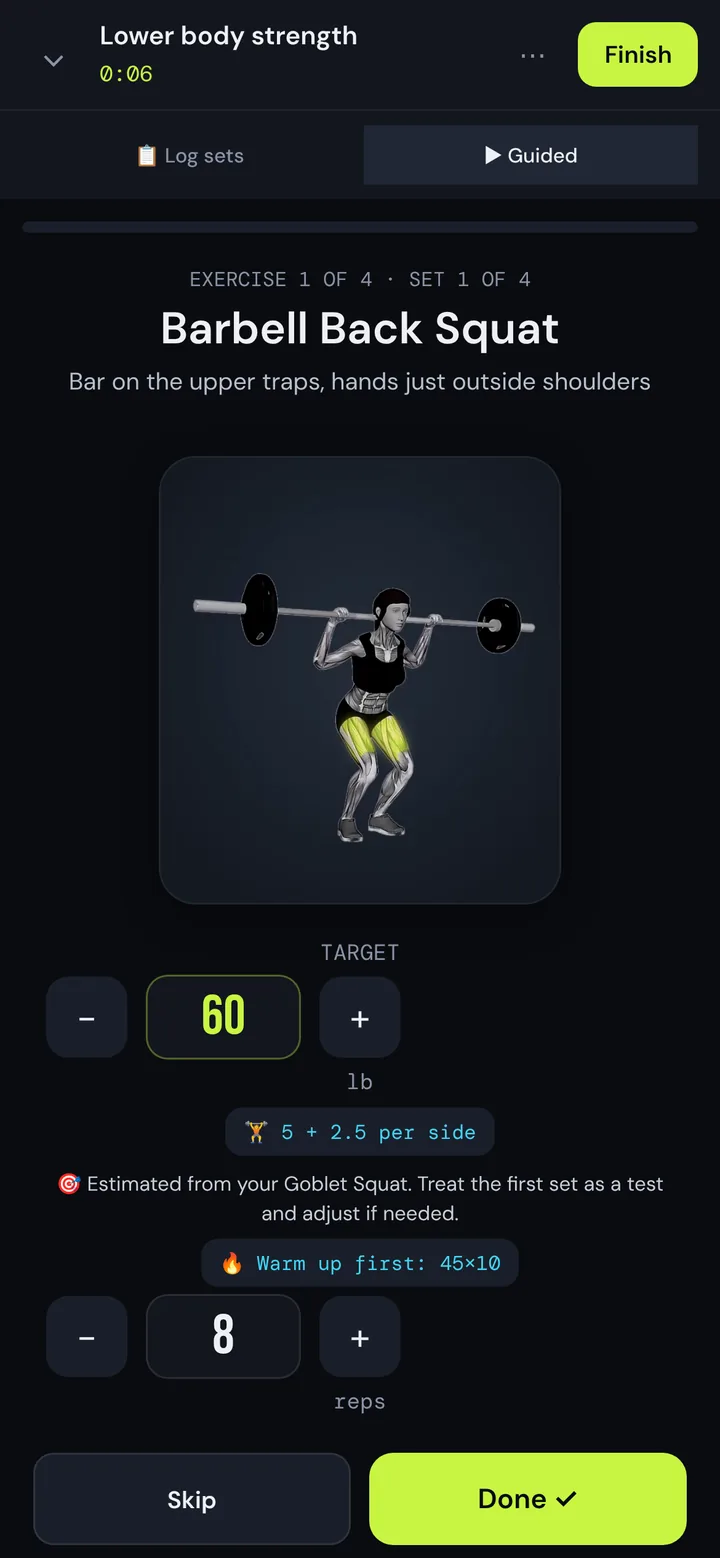
Every weighted exercise gets a suggested weight. Once you've logged it, Levelwell uses double progression, based on your last session with that lift:
| Last time, at that weight | Next time |
|---|---|
| Every set at the top of your rep range | One step heavier, back to the bottom of the range |
| 3 or more reps past the top | A bigger jump, worked out from your estimated max |
| Within the range | Same weight, aim for one more rep |
| Short of the range | Lighter: at least one step, worked out from your estimated max |
1-rep max = weight × (1 + reps ÷ 30) (reps counted up to 20)
- Time off: 3 weeks away eases the weight to 92%, 6 weeks to 85%.
- New rep range: after you change your goal, the weight is worked out from your estimated max for the new reps.
- During a workout: beat your target by 3 or more reps and the next sets go up; fall 3 or more short (or under 60%) and they come down, by no more than 15%. You can turn this off.
- Real weights only: barbells move in 5 lb / 2.5 kg steps, dumbbells and kettlebells follow real sizes, and assisted machines go the other way, with less assistance meaning progress.
Your first weight
Before you've logged a lift, Levelwell estimates it. It uses your own data first: a test set you enter on the exercise sheet, then lifts with the same movement pattern, then any of your lifts. Only if you have none does it fall back to strength standards scaled to your body weight, sex and age.
standard = lift ratio × sex factor × ref × (body kg ÷ ref)^0.67 × age factor
ref: 80 kg men · 63 kg women
sex factor: men 1 · women 0.75 lower body, 0.65 core and carries, 0.58 everything else
age factor: 1 from 16 to 40, then 1% less a year to a floor of 0.72
level: Beginner × 0.55 · Intermediate × 0.85 · Advanced × 1.1
Lift ratios are an intermediate man's one-rep max as a multiple of body weight, for example squat 1.5, bench press 1.25, deadlift 1.85, overhead press 0.75, barbell row 1.0. First weights leave one extra rep in reserve and are rounded down on purpose.
Warm-ups and plates
19 big lifts get warm-up sets, from the bench press and squat to the leg press and lat pulldown.
- Get stronger and Build muscle: 40% × 8, 60% × 5, 80% × 3. Other goals: 50% × 10, 75% × 5.
- Barbell lifts start with the empty bar × 10 when the work weight is over 1.5 times the bar. Steps too close together are skipped, and there are never more than 4.
- Example: bench 185 lb for Build muscle → 45 × 10, 70 × 8, 110 × 5, 145 × 3.
per side = (weight − bar) ÷ 2
bar 45 lb / 20 kg (35 lb / 15 kg light bar in settings)
lb plates 45 · 35 · 25 · 10 · 5 · 2.5   kg plates 25 · 20 · 15 · 10 · 5 · 2.5 · 1.25
135 lb is a 45 on each side. 225 lb is two 45s on each side. 100 kg is 25 + 15 on each side.
Workout calories
Workouts count active calories, set by set. Each finished set counts its own time, including the rest after it, at that exercise's MET.
kcal = Σ (MET − 1) × kg × set hours
MET: stretches 2.3 · bodyweight 3.8 · weights 5 · cardio 7 · HIIT 8
- A set's time runs from your previous tick to this one, but never more than twice its planned time plus a minute, so a long break isn't counted as exercise.
- All sets together can't add up to more than the workout's own clock time (4 hours at most).
Whether workouts add to your food budget is your choice: see Workout calories in your budget.
XP, records and quests
XP = 40
   + 3 per set          (up to 30 sets)
   + 1 per minute       (up to 90)
   + 30 per record      (up to 5)
   + 20 for a program session
short session (under 5 min and under 3 sets): 10 XP · 4th workout of the day and later: 10 XP
- Personal records: a higher estimated max on a weighted lift, more reps on a bodyweight move, or a longer or heavier hold. One per exercise per workout. The first time you log a lift sets the record.
- Volume is weight × reps over every finished set.
- Quests: Finish a workout (+70), Log 12 sets (+70), Train for 40 minutes or more (+120), Set a personal record (+120), Work out and hit your step goal (+120). Rest days get no workout quests.
- Finishing a whole program: +500. A weekly challenge to complete your workouts pays +300.
- Missed workouts: with training days, a missed planned day costs 40 XP, given back if you make it up that week. Without training days, each workout short of your weekly goal costs 40 on Sunday (3 at most).
- Badges: 1, 10, 50, 100, 250 and 500 workouts (+50 up to +3,000), 100, 1,000 and 5,000 sets, 1, 25 and 100 records, plus early-bird, night-owl and weekend badges.
Exercises and 3D guides
- 1,828 exercises: 828 upper body, 346 lower body, 223 core, 208 mobility and stretching, 88 glutes, 84 cardio and 51 HIIT. 809 get a suggested weight.
- Every exercise has a 3D guide: a looping clip of an athlete with the working muscles lit in lime. 995 exercises have both a woman and a man, and the one matching your profile plays. With Reduce motion on, you see a still.
- A guide downloads the first time you open it or start a workout with it, then plays offline.
- The muscle map shades 10 muscle groups by recovery, and its 30-day view counts the days you trained each one.